
Introduction
Rescue dogs often need time to feel safe in a new home. Some settle quickly, while others struggle whenever their person leaves. Understanding the Signs of Separation Anxiety in Rescue Dogs: Proven Calming and Desensitization Routine can help owners respond with patience and consistency.
Separation anxiety is more than ordinary whining after you leave. Affected dogs may panic, bark continuously, pace, destroy doors, or attempt to escape. Some also have accidents despite being house-trained.
Fortunately, many dogs can improve with gradual training and predictable routines. The goal is not to force independence overnight. Instead, you teach your dog that being alone is safe and temporary.
What Is Separation Anxiety in Rescue Dogs?
Separation anxiety occurs when a dog experiences significant distress when separated from a person or people they depend on. Rescue dogs may face additional challenges because their previous experiences are often unknown.
A dog may have experienced abandonment, multiple homes, kennel stress, or sudden environmental changes. However, being a rescue dog does not automatically mean the dog will develop separation anxiety.
The condition can also develop in dogs without a rescue background. Changes in household routines, moving homes, loss of a companion, or long periods alone can contribute.


The important point is to observe behavior rather than assume its cause.
Signs of Separation Anxiety in Rescue Dogs
Recognizing the signs early makes training easier. Some behaviors appear before you even leave the house.
Anxiety Before You Leave
A dog with separation anxiety may become restless when you prepare to go. Picking up keys, putting on shoes, or reaching for your bag can trigger anxiety.
Your dog may follow you closely around the house. They may stare at the door or become unusually vocal.
These behaviors suggest that departure cues have become associated with isolation.
Barking, Whining, or Howling
Persistent vocalization after departure is another common sign. A dog may bark, whine, howl, or cry for extended periods.
Occasional barking does not automatically indicate separation anxiety. The pattern matters.
A camera can help you understand what happens after you leave. It can reveal whether your dog settles after several minutes or remains distressed.
Destructive Behavior
Some anxious dogs chew doors, window frames, furniture, or personal belongings. Destruction may be concentrated around exit points.
This behavior is usually not revenge or disobedience. The dog may be attempting to escape or relieve intense emotional distress.
Punishing destruction can increase fear. Instead, focus on reducing the anxiety behind the behavior.
Pacing and Repetitive Behavior
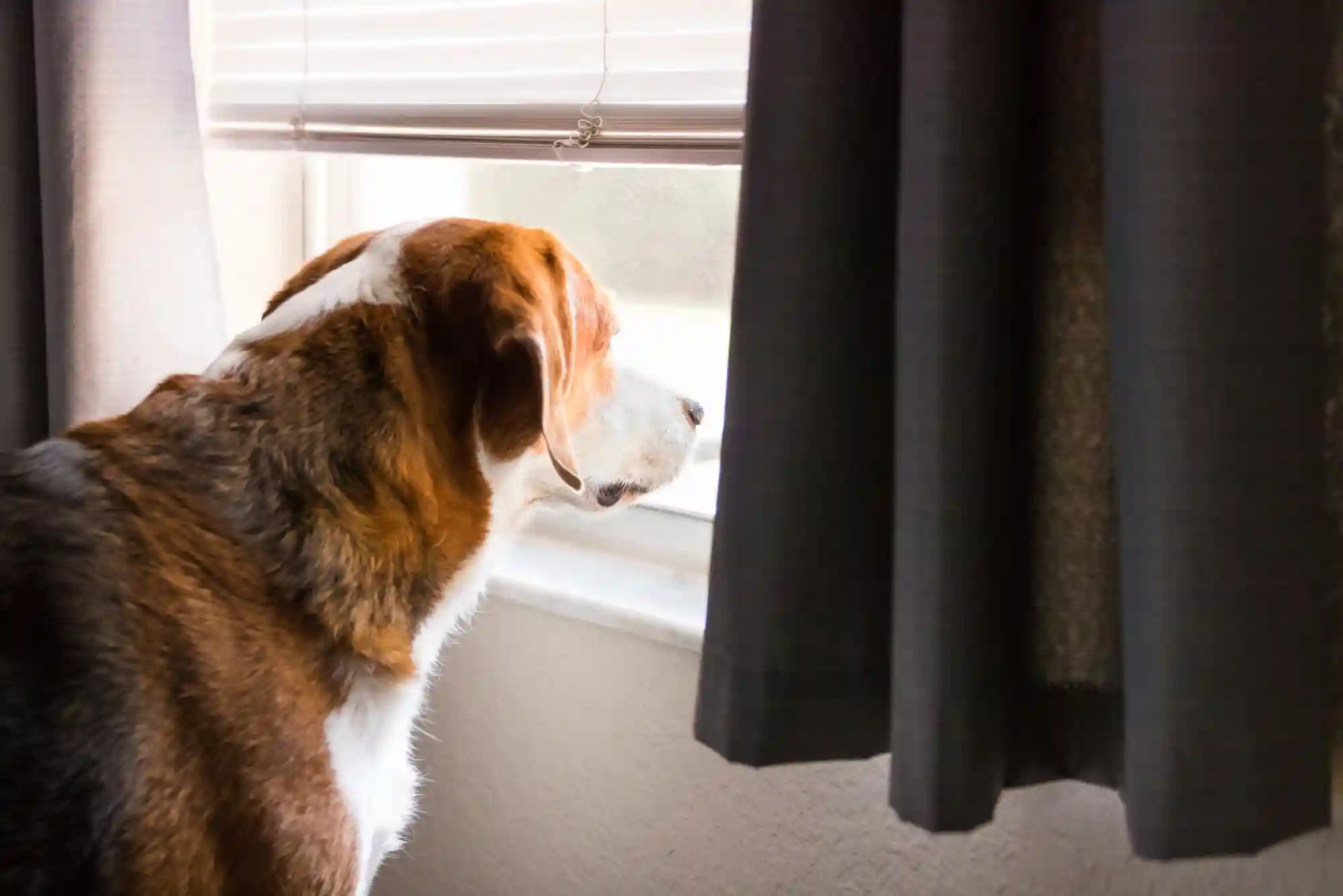
An anxious dog may repeatedly walk between rooms or pace near the entrance. Some dogs circle, pant, drool, or repeatedly check windows.
These behaviors can occur even when the environment is otherwise calm.
Recording your dog when alone can provide useful information for identifying patterns.
Indoor Accidents
Some dogs urinate or defecate only when left alone. This can happen even when they normally eliminate outdoors.
However, medical problems can also cause sudden house-soiling. A veterinary examination is therefore important when accidents appear unexpectedly.
Escape Attempts
Severely distressed dogs may scratch doors, push through windows, dig at barriers, or attempt to escape crates.
Escape behavior can cause serious injuries. For that reason, severe cases deserve professional guidance rather than trial-and-error training.
How to Tell Separation Anxiety From Normal Behavior
Not every lonely dog has separation anxiety. Many dogs simply become bored when left alone.
A bored dog may chew an accessible toy or sleep for several hours. An anxious dog may show escalating distress soon after departure.
Timing provides an important clue. If symptoms consistently begin when the owner leaves, separation-related distress becomes more likely.
A camera can make this distinction much easier. Observe your dog’s first 30 to 60 minutes alone when possible.
Start With a Calm, Predictable Environment
Before beginning desensitization, make your dog’s daily routine predictable.
Regular meals, walks, rest periods, and bedtime can reduce unnecessary uncertainty. Exercise can also help, although exercise alone does not cure separation anxiety.
Create a comfortable resting area where your dog can relax without being disturbed.
Offer safe enrichment when appropriate. Food puzzles, chew items, and sniffing activities can provide constructive engagement.
However, never introduce a new enrichment item without considering whether it is safe for unsupervised use.
The Proven Calming and Desensitization Routine
A gradual desensitization routine teaches your dog that separation does not always lead to panic.
The process begins with absences that are short enough to remain below your dog’s anxiety threshold.
Begin With Departure Cues
First, practice departure signals without actually leaving.
Pick up your keys and then sit down. Put on your shoes and continue with another activity.
Repeat these exercises calmly. The goal is to weaken the connection between departure cues and panic.
Avoid making these sessions dramatic. Your movements should become ordinary and predictable.
Practice Very Short Absences
Next, step outside briefly and return before your dog becomes distressed.
For some dogs, this may mean only a few seconds. For others, several minutes may be manageable.
There is no universal starting duration. Your dog’s behavior should determine the starting point.
If your dog becomes anxious, shorten the next repetition.
Increase Time Gradually
Once short absences remain calm, increase the duration slowly.
For example, you might practice 10 seconds, then 20 seconds, followed by 30 seconds. Later, you may progress to one minute and beyond.
Do not increase every session. Sometimes repeating an easy duration builds greater confidence.
Progress should be based on relaxed behavior rather than a fixed timetable.
Keep Departures and Returns Calm
Your behavior can influence the emotional tone around departures.
Avoid creating a dramatic goodbye ritual. Leave calmly and return without overwhelming excitement.
This does not mean ignoring your dog. Instead, keep departures predictable and emotionally neutral.
Over time, leaving becomes an ordinary household event.
Why Flooding Can Make Anxiety Worse
One common mistake is leaving an anxious dog alone for a long period and hoping they will eventually adjust.
This approach can expose the dog to overwhelming fear. Instead of learning that solitude is safe, the dog may repeatedly experience panic.
Desensitization works differently. It exposes the dog to manageable separation while keeping distress low.
That distinction is especially important for rescue dogs that may already have uncertain experiences with abandonment.
Build Independence While You Are Home
Separation training does not only happen when you leave.
Teach your dog that relaxing away from you is safe. Encourage your dog to settle on a comfortable bed while you work nearby.
Gradually increase the distance between you. Move into another room for short periods when your dog remains relaxed.
You can also reward calm independent behavior without constantly calling your dog back.
This creates opportunities for your dog to practice being comfortable without direct contact.
Avoid These Common Training Mistakes
Punishment is one of the biggest mistakes owners can make. Yelling after destruction does not teach a dog how to cope with separation.
Another mistake is progressing too quickly. If your dog panics at two minutes, repeatedly practicing ten-minute absences may undermine progress.
Inconsistent routines can also make training harder. Try to maintain predictable practice sessions whenever possible.
Finally, avoid assuming that every rescue dog needs the same approach. Temperament, history, environment, and individual behavior all matter.
When Should You Contact a Veterinarian?
A veterinary consultation is appropriate when anxiety is severe, sudden, or accompanied by physical symptoms.
Medical conditions can sometimes resemble anxiety. Pain, urinary problems, gastrointestinal issues, and other conditions may change behavior.
A veterinarian can also help determine whether additional behavioral support is appropriate.
For serious separation-related distress, a qualified veterinary behavior professional or experienced behavior consultant can provide individualized guidance.
Medication may sometimes be considered alongside behavior modification. It should only be discussed with an appropriate veterinary professional.
How Long Does Separation Anxiety Training Take?
There is no fixed recovery timeline.
Some dogs show noticeable improvement within weeks. Others require several months of consistent work.
Progress can also fluctuate. A stressful event, household change, illness, or disrupted routine may temporarily increase anxiety.
Instead of measuring success only by the number of minutes your dog stays alone, watch the quality of their behavior.
A relaxed five-minute absence can represent meaningful progress.
Frequently Asked Questions
How do I know if my rescue dog has separation anxiety?
Look for repeated distress specifically associated with being left alone. Common signs include barking, pacing, destruction, escape attempts, accidents, panting, and persistent restlessness.
A camera can help you identify what happens after you leave. A veterinarian can also help rule out medical explanations.
How do you calm a rescue dog with separation anxiety?
Start by creating predictable routines and a safe resting environment. Then use gradual desensitization with very short absences.
Avoid forcing long separations before your dog is ready. Reward calm behavior and increase duration gradually.
Can separation anxiety in dogs be cured?
Many dogs can improve substantially with appropriate behavior modification. Some require long-term management.
The outcome depends on the individual dog and the severity of their distress. Consistency is usually more useful than rushing the process.
Should I crate a dog with separation anxiety?
A crate can be helpful for some dogs, but it is not appropriate for every anxious dog.
If your dog panics inside the crate, confinement may increase distress or create injury risks. Introduce crate training separately and gradually.
How long can a dog with separation anxiety be left alone?
There is no single safe duration for every dog with separation anxiety.
The appropriate duration depends on the dog’s current anxiety threshold. Training should begin below the point where distress starts.
Conclusion
Understanding the Signs of Separation Anxiety in Rescue Dogs: Proven Calming and Desensitization Routine gives owners a practical foundation for helping a worried companion.
Watch for anxiety around departure cues, vocalization, pacing, destruction, accidents, and escape attempts. Then focus on predictable routines and gradual exposure to short absences.